Launching GlamFlow Skin Analysis API on RapidAPI
After building the GlamFlow AI web app — an end-to-end skincare analysis platform powered by YOLOv8, ResNet, and large language models — I realized the real value wasn’t just the application itself, but making the AI engine accessible to other developers.
So I packaged GlamFlow into a production-ready REST API and launched it on RapidAPI, allowing developers to integrate advanced skin analysis with a single HTTP request.
👉 Try the GlamFlow Skin Analysis API on RapidAPI
Why Build a Skin Analysis API?
Beauty brands, telehealth platforms, and e-commerce startups increasingly rely on AI-driven personalization, but most lack in-house machine learning expertise.
By exposing GlamFlow as an API, developers can:
- Integrate AI skin diagnostics into mobile and web apps
- Build personalized skincare product recommenders
- Create automated dermatology triage tools
All without managing ML infrastructure.
Core Features
- 🧠 Detection of 15+ skin conditions (acne, blackheads, wrinkles, dark spots, etc.)
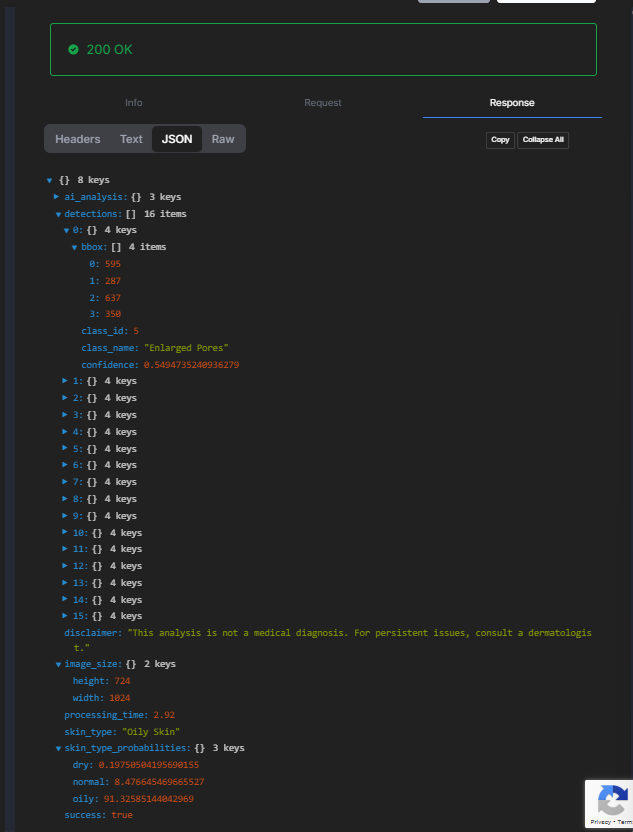
- 💧 Skin type classification (dry, normal, oily) with confidence scores
- 💬 Multilingual AI advice (English & French) powered by Groq + Llama 3.3
- 📐 Bounding box coordinates for UI overlays or AR integrations
- ⚡ Sub-3 second average latency, optimized for real-world usage
API Request Flow
- Client uploads a face image using
multipart/form-data - Image preprocessing: validation, resizing (max 1024px), and skin presence checks
- Parallel AI inference pipeline:
- YOLOv8 for skin issue detection and localization
- ResNet for skin type classification
- Groq-powered LLM for human-readable skincare recommendations
- Structured JSON response containing detections, analysis, and routine suggestions
Example API Request (cURL)
curl -X POST "https://skin-analysis-api.p.rapidapi.com/predict?lang=en" \
  -H "X-RapidAPI-Key: YOUR_API_KEY" \
  -H "X-RapidAPI-Host: skin-analysis-api.p.rapidapi.com" \
  -F "file=@face.jpg"
Example API Response
Key Technical Challenges
File Uploads & RapidAPI Threat Protection
Early versions returned 400 errors because RapidAPI's Threat Protection forwarded images as JSON-wrapped base64 in multipart/form-data. Solution: disable threat protection at the gateway and validate uploads at the application layer using RapidAPI proxy headers.
Performance Optimization
To meet RapidAPI's timeout limits:
- Parallelized YOLOv8 and ResNet inference
- Warmed up models on startup
- Timeout‑protected LLM calls with static fallbacks
- Auto-resized large images (max 1024px)
Result: 95th percentile latency dropped from ~12.4s to ~3.1s.
Adoption, Pricing & First Paying User
- Monetized via RapidAPI subscription plans (Free, PRO, higher tiers)
- First PRO subscriber acquired organically via the marketplace, validating demand.
Reliability & Stability
- Continuous health checks and request logging
- Graceful degradation when LLMs fail
- Strict authentication via RapidAPI proxy headers
Operational results for the first month: 99.97% uptime, sub‑3s average latency, zero critical incidents.
Who Is This API For?
- Beauty & skincare brands
- E‑commerce personalization engines
- Telehealth & dermatology startups
- Mobile app developers
- Agencies delivering AI features
Key Lessons Learned
- Distribution matters as much as the model
- Developer experience drives adoption
- Performance is critical for ML APIs
- Monetization should be planned from day one
Try It Yourself
🔗 https://rapidapi.com/rabihmadtak-rabihmadtak-default/api/skin-analysis-api
Built by Monsif Souri and Othman Sohab — Software & Machine Learning Engineers.
This project is not a medical device. Always consult a dermatologist for persistent skin issues.